
There is plenty of data available that demonstrates that over 50% of software development projects fail.
66% of techbology projects (based on the analysis of 50,000 projects globally) end in partial or total failure. Despite larger projects being more prone to encountering challenges or failing altogether, even the smallest of software projects fail one in ten times.
Source: Standish Group's Annual CHAOS report. The standish Group is an independent international IT research advisory firm founded in 1985.
There is plenty of data available that demonstrates that over 50% of software development projects fail.
There are a myriad of reasons why this is the case but at the heart of the financial and risk issue is the traditional means of building software.
A whole industry has been developed that revolves around the writing of complex source code, using a variety of ever changing software programming languages.
As a Customer - whether you employ an inhouse team or outsource – you bear the cost of salaries, day rates, and all that goes with this. Usually with little or no guarantee of success.
My referring to the traditional way of building software is by no means malicious. The simple fact is that using traditional programming languages is complex and expensive to build and then maintain. Maintenance alone can take as much as 30% of a developer’s time.
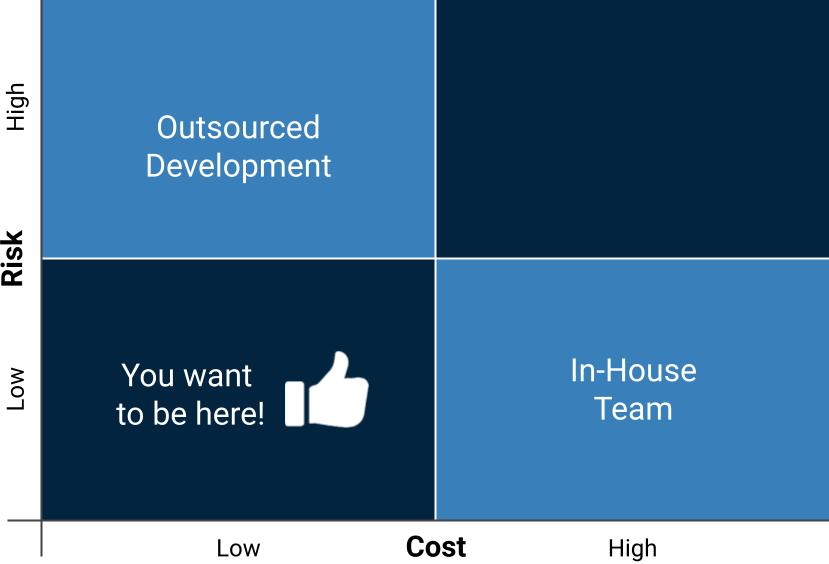
The traditional models for building software deliver different risk/cost profiles:
The corporate risk of building software is one of obsoletion. With new technology becoming available at an alarming rate you run the very real risk of having to rewrite software every few years (used to be every 5-6, now more like 2-3). Often these rewrites come at a similar price to the original development.
What are the attributes of a new low cost, lower risk model for software development? I have a series of 6 points that I will elaborate on over the next few weeks:
1. A new development approach that improves your time to market

One of the main reasons that software seems to take so long is the fact of having to create “source code”. Whilst it is the traditional way of building software, in our view the process is overly complex and time consuming.
As an industry there is a direction of travel to reduce this with a myriad of “low code” and “no code” solutions. According to Gartner, 65% of application development will be low code by 2024.
Whilst the optimists suggest this means that in the future much of the software will be created by business people not IT experts – I believe the truth will be a long way from that.
2. Documentation of the system is out of date or non existent

How often have we heard that a system isn’t properly documented? Even if it is properly documented, as no two development teams are the same, in truth it is a highly complex task to read and understand another team's source code.
Keeping software properly documented through all the changes, improvements, bug fixes etc is a time consuming job.
The advantage of a software development methodology based on metadata is that the metadata becomes the documentation so the application is always 100% upto date and the documentation can be reviewed and printed out at any time.
The truth is – even for well documented source code, reading someone else's code is very challenging and in truth often easier to start again.
3. You are not futureproofed against end of life

You’re on a constant cycle of having to redesign/rewrite software every few years. This can be because your code has lacked the proper support and maintenance. It is also because the underlying technologies are changing all the time and you need to keep these updated in your application to ensure you keep the lights on.
The good news is that there are much better things you could be doing with your time/money.
4. In-house development may seem attractive at first glance, but it may not be the best solution

Whilst an in-house team has the attraction that you can eyeball the team on a Monday morning, more and more companies are realising that this is actually more complex and expensive than first imagined.
In mitigating the obvious shortcomings of a traditional outsourcing model, more and more companies are opting for an outsourced partner model.
By sharing the risk and incentivising the partner on success and value add, helps cement the right behaviours and focus from both teams. Delivering this as a managed service and ensuring you have an effective exit strategy should you want to go in another direction, is a solution that we believe is becoming more popular in this post pandemic world.
5. All the risk is on you and your company

Traditional outsourcing involves you paying a day rate in return for a set of resources. So in essence, you are paying for the costs whilst assuming all the risk on the project.
Creating software using a traditionally outsourced team is only one element of the process - ongoing maintenance, even when planned properly, poses further challenges. One of these is your team having to pick up the code created by a 3rd party. Any IT professional will tell you that this is often far easier said than done
Time spent on maintenance is another area that becomes problematic. Surveys have shown that at least 30% of time spent is on maintaining the software and ensuring it is kept up to date. This is 30% fewer hours spent on innovation and developing new capabilities.
All the cost and all the risk is for your account. At the end of the day, you and your company have to pay. But it’s all about how you pay which makes all the difference. Traditionally, you’re either paying full-time salaries or a day rate, irrespective of delivery. There is another way.
At the end of the day, you and your company have to pay. But it’s all about how you pay which makes all the difference. Traditionally, you’re either paying full-time salaries or a day rate, irrespective of delivery.
You have other options.
6. Opting into a long-term partnership

Choosing the partnership model lowers your risk by entering into a long-term partnership with a 3rd party that is remunerated on delivery and long term value.
It lowers your risk by using the benefits of modern technology by adopting a no-code environment rather than traditional coding. This will also future proof you from changes in underlying technology.
It lowers cost – in that you don’t have the fixed overheads of a multi-disciplined software development team that needs to be kept current. A no-code platform is quicker, cheaper to not only create but also maintain.