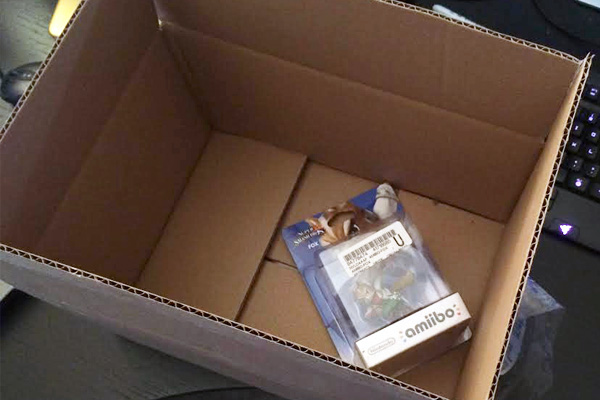
Now that we are officially in a recession, working to retain your existing customers at all costs is an obvious priority. Unfortunately, your customers are making it clear they hate your wasteful packaging and you’re neglecting to make the necessary changes to optimize… don’t say we didn’t warn you.
Last year it was reported that online retail sales of physical goods amounted to $365.2 billion in the United States alone. That number is expected to close in on $600 billion in the next four years and that’s not taking into account a recent survey that indicates a 10-30% increase in online sales due to COVID-19. That said, the pandemic is only accelerating a trend that was already well underway, with no end in sight.
Six out of ten reasons why customers do not return to an e-commerce company has something to do with shipping, such as inaccurate shipping charge estimates, a poor return policy, transit that takes too long, and of course, lousy packaging.
Best-in-class companies understand this. They are on the pulse of social media, they know their customers, and they’re taking steps to address it. Laggards aren’t, and are often blissfully unaware as to why they can’t increase repeat customers or even retain existing customers in this increasingly eCom-driven environment. It’s because a poor customer sustainability experience is damaging their brand .
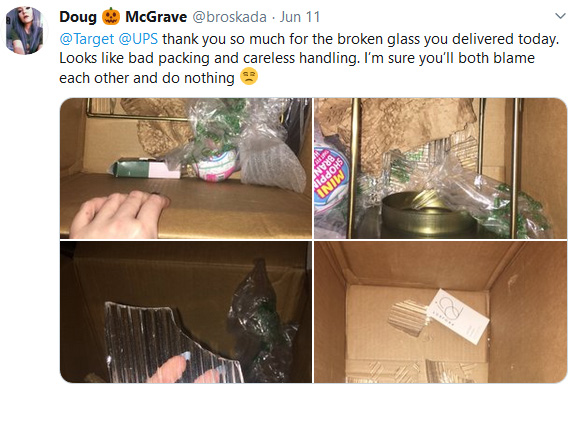
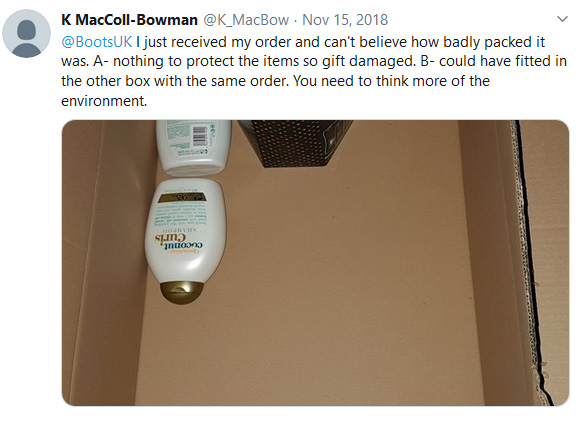
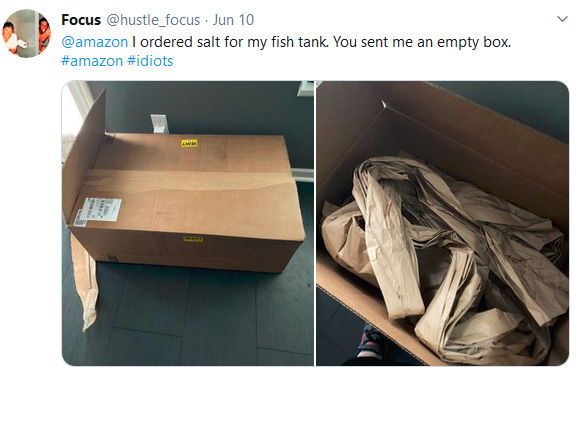
Below are a just few examples of unhappy customers speaking out.
You can click on the images to enlarge them.
These days in a typical supply chain, everything is controlled except the packing process. If you're not optimizing your packing, you’re wasting money, harming the environment, and ultimately frustrating your customers. It doesn’t have to be this way. With just a few tactical upgrades to your Order to Cash or Procure to Pay processes, you can begin efficiently packing orders, save money by eliminating unexpected dimensional surcharges, and optimize your customers’ sustainability experience.
What a Waste
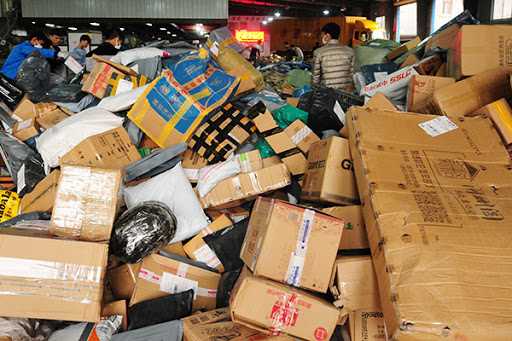
To make deliveries in 2019, online retailers produced 10,000 tons of packaging waste. Since eCommerce first boomed, it didn’t take long for consumers to start naming and shaming retailers like Amazon and Walmart on Twitter for their excessive carton fill. When a pen refill gets shipped in a large box stuffed with bubble wrap and peanuts your brand dies a little bit. It shows little thought for the environment, it forces customers to deal with more trash and truthfully, it’s kind of embarrassing for everyone involved.
Badly packed boxes go out the warehouse door for many reasons. It’s easy to call it pure negligence, but consider the immense pressure put on supply chain managers to keep a high level of throughput, to say nothing of the packers themselves who are encouraged to assemble orders as quickly as possible.
Since many warehouse staff are being paid based on throughput, this is also a good motivation for how fast they can pack and get parcels out the door and onto the truck.
Without comprehensive instructions and proper controls in place, it’s nearly impossible to pack fast and efficiently—guesswork and tribal knowledge reigns.
Oftentimes a company’s busy season is when the most packing mistakes are made; the need to handle greater order volume puts even greater pressure on warehouse staff. With the new B2C delivery-centric economy driven by COVID-19 and a 146% increase in all online retail orders in North America, companies must contend with a year-round surge. An influx of inexperienced staff to help with the surge of orders, combined with employees who aren’t motivated to pack properly, only exacerbates the problem.
The “Air Tax”: No company wants to pay their carriers to ship empty boxes, but without a better system, their poor packaging ends up trending on Twitter and they stand to lose another customer.
Fitting More in the Truck
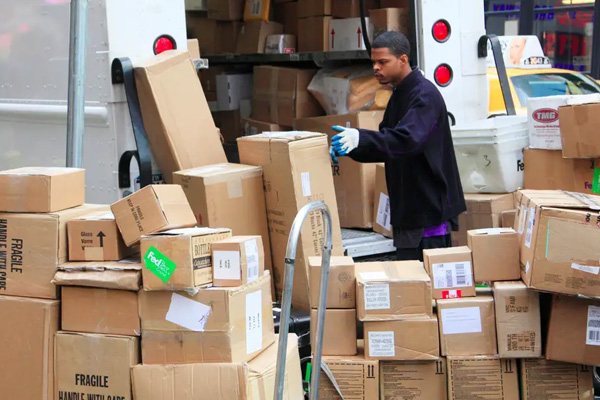
The issue of sustainability doesn’t stop with wasted corrugated or carton fill. Delivery trucks are jam-packed. This has become an acute issue in the past few weeks for carriers who have a vast network of trucks, trains and planes and have had to stop picking up packages from even large popular retailers in the US because they simply don't have the capacity.
It really is an unthinkable concept that a retailer would need to limit the number of packages they ship out before a carrier cuts them off, but this is the reality they’re faced with today.
Since the carriers started adding COVID surcharges, reducing the size and number of your boxes means you’re not only delighting your customers by practicing sustainability, you’re taking practical steps to lower the burden on the whole supply chain and making sure your packages get on the truck.
Cartonization

With rate tables and dimensional weight fees, carriers have long incentivized boxes that are packed more densely, especially when the mode of transportation is more polluting. For example, for zones that require planes, dimensional weight fees are highest and minimum base box costs are lowest. In this way, air cargo carriers incentivize the smallest total cubic volume even if the order has to be split up into many boxes to achieve it.
This is a mode-specific packing incentive that is impossible and impractical for your packers to “eyeball.” How cartonization helps is by analyzing items in every order and all costs associated with fulfillment to determine the most efficient way to pack and ship them.
At Paccurate, we reduce at least 20% of the cubic volume of our client’s shipments. That means they can fit more boxes on the truck, using less trucks and airplanes, and ultimately emit less CO2.
Making packing more efficient reinforces the strong link between transportation cost savings and lowering your company’s carbon footprint. You essentially can provide a great customer sustainability experience for free. How often do sustainability initiatives result in an immediate net cost savings?
Packing Smarter
As carriers continue to lower dim factors, the effect is that you pay more based on dimensional weight instead of actual weight. Sizes and prices differ from one shipping carrier to the next. For example, one large box from FedEx might be cheaper than two smaller boxes from UPS carrying the same items.
What this all really comes down to, is that you ought to be implementing a controlled process that can instantly calculate the most efficient and cost effective solution.
This will help eliminate unexpected dimensional weight fees which can really add up. You need a cartonization engine that can make snap decisions about which packing solution and carrier is best for every order.
Paccurate was designed to look at all shipping, material, and labor costs associated with every order, and helpfully direct even seasonal packers toward the best, most cost-efficient packing method.
Through this process, packers are able to take control of their packing process and delight their customers, leaving Twitter trending to the politicians and reality TV stars.
If you have any questions, please reach out. I’d love for you to try our API for free at paccurate.io.



 Powered by Majestic3.com