Insights about the beleaguered doctor
by Dr Conrad Smith


 |
| Dr Conrad Smith |
Conrad is a general practitioner at a busy family practice where he calls himself a half-day doctor. The other part of the day he pursues a career in business where he enjoys innovation and the modernisation of business models and pharmaceutical marketing strategies. He has received several business awards, including joint winner as the Innovator of the Year (Entrepreneur of the Year Contest), and was a joint finalist in two National Business Award categories (Business Entrepreneur & Fastest growth SMME). He has also won two creative design awards for products unrelated to the medical field and has written a screenplay that was chosen to represent South Africa at the International Film Festival in Cannes.

Since bad news sells, chew on this: doctors are burning out left right and centre and the problem is global. According to stats, 40% of US physicians screened positive for depression. Over 7% had thoughts of killing themselves in the previous 12 months, compared with 4% for the general population. And doctors don’t just think about suicide more than the public - they actually attempt it more often. Greater knowledge and uninhibited access to drugs mean physician completion of suicide is much higher than that of the public, with female doctors more successful than their male colleagues.
According to a study, a large portion of British physician’s reported that they are suffering from some definable form of mental ailment while 66% in Germany declare burnout. China takes the cake at 82%. [Download the full 70-page report below]
So, let’s ask the academics at our alma maters to help us solve our predicament.
Are you kidding!!?
They’ll want to send us back to medical school for more training in psychiatry, and we’re already so pressed for time. Actually, from what I have learnt in the business world, more psychiatry won’t help us, that is of course unless your ambition is to become a psychiatrist, or you are ready to do a stint in a psych ward as patient. What we as doctors need is better strategy. And since the problem is occurring on such a grand scale all around us and may even be affecting some of your friends who are doctors, we need to tackle the problem amongst ourselves, not wait for someone else to come and save us, but from what exactly? Our patients, our mindsets or our jobs?
We are told that doctors burn out because they work too hard, spend too many hours caring for patients and are burdened with too many bureaucratic tasks. This may be true, but how do we as doctors compare our workload, remuneration and sacrifice with other professionals such as accountants, lawyers and engineers? A standard prerequisite of all these professions seems to be the obvious investment of countless hours into hard work and bureaucratic tasks - especially if you aspire to get anywhere near the top. And what about all the thousands of individuals in the allied medical professions, such as nurses and physio’s, or allied medical sectors like retail pharmacies, pharmaceutical companies, hospitals and pathology groups? Are they also lurching and about to keel over?
Every day we encourage our patients to embrace courage, adopt new coping skills and deal with disease and disability in a more creative or inspiring way. “Show some pluck” or “take it on the chin” conveys the basic idea. But just how plucky are we as doctors? How do we deal with this multidimensional, intangible and elusive concept ourselves?
Some individuals display certain psychological and behavioural capabilities that allow them to consistently remain calm during crisis and chaos. Afterwards, they are able to move on without any demonstrable physical and psychological ill effects. Some even flourish over the long term.
In psychometry, this trait is termed ‘resilience’ and is defined as a mental attitude enabling one to naturally cope with adversity, stress and an ever-changing environment. Resilience is a useful attribute to have in most high-stress jobs and personality testing therefore forms a mandatory part of the selection process for many professions, a good example being the aviation industry. Screening in medicine, however, continues to place an inordinate emphasis on intellect, and largely ignores these unconscious aspects of cognition when selecting medical students. Non-technical skills involving teamwork, decision-making, situational awareness, stress management and coping with fatigue are also taught extensively to pilots during training. Very little of this is imparted to medical students, and once out there in private practice, it appears that you are essentially on your own.
Interestingly, several studies conducted on medical students (USA, Australia and Korea), GP interns (Australia) and anaesthetists (South Africa), have revealed that doctors fare reasonably well when it comes to resilience, at least at the start of their careers (see references below). But why does Resilience appear to diminish as a doctor becomes more mature or better experienced? Surely one would expect the opposite?

A common theme when explaining doctor burnout revolves around long working hours and being overloaded with too much bureaucracy. It is also often suggested that doctors don’t feel appreciated. Hmmm, perhaps. Then there are many economic reasons, and although these are real, they are certainly not only unique to doctors. Everyone is feeling the squeeze and healthcare costs are far too high in most parts of the world. You also can’t just ask for more money because of your qualification or status. The reality is that you are in direct competition with many others also making their living from the funds derived from the sick and ailing. To pay Peter, you most likely have to rob Paul (less 10% for handling, of course). But to keep Peter happy, can you count on the continual “cooperation” of Paul?

Many powerful players compete against doctors for a far bigger slice of the healthcare pie. Their income is directly proportional to the magnitude and success of their marketing campaigns and advertising budgets. Since the regulatory framework actively prohibits doctors from advertising or promoting their services in many parts of the world, this highly strategic business process puts doctors at a disadvantage. Even worse, most doctors don’t think about marketing, not themselves, their practices or their professions.
In the meantime, many other players have invested thousands of hours into refining their commercially driven business enterprises via highly effective marketing machines. A key component ensuring their marketing success is centred upon the development of the concept ‘customer service’, the new commercial term for ‘patient care’, but with a subtle difference. Since these players deliberately spend a lot more time, money and effort on keeping patients happy, they can easily outperform doctors.
As a result, patient-centricity is now rapidly becoming a medical buzzword. Since patients are modern consumers, they are more orientated towards self-service and self-help strategies. Statistics indicate that they now increasingly rely on the internet for medical advice and are becoming more empowered to actively engage in how they would like to be treated. This puts more pressure on doctors. Improved doctor-patient communication and patient education have never been as important as it is now, processes that all consume the doctor’s time.
Ever heard the term GOMER? If not, you’re probably not a doctor, since this acronym is widely used by doctors and medical students to describe a certain ‘type’ of patient. It stands for: Get-Out-My-Emergency-Room.
For obvious reasons, it is only used sotto voce and behind closed doors. In public, the more PC term is “difficult patient”. A key feature of difficult patients is that they consume a disproportionate amount of the doctors’ time and mental resources. It is estimated that 15-20% of patients could fall into this category.
Difficult patients are demanding, neurotic, phobic, irrational or narcotic-seeking. They frequently present with exaggerated symptoms, often unrelated. Ordinary thinking cannot be relied upon to solve these problems - the doctor’s mind needs to transcend into hyperdrive.
Their opinions, expectations and interpretations of disease are typically based upon a lack of knowledge and insight. That’s to be expected, and that’s why we have a job – we need to help them understand and make sense of it all. However, when their symptoms, thoughts, ideas and feelings are muddled together in a maelstrom of illogical logic, and then presented as a tirade of disjointed, chaotic and fragmented concepts, it becomes a massive problem for the doctor brain. To be more precise, the analytic brain trying to make sense of chaos, keep track and categorise each problem so that the most practical and cost-effective solution can be implemented. In the meantime, since the waiting room is filling up, pressure starts to mount for the doctor…
But never mind the constant pressure, doctor, no slacking-off allowed here! At the backdoor, just out of sight, lurks the malpractice lawyer, the legal guardian of the Hippocratic oath. Just dare put one foot out of place or make one silly slip-up and you can be sure that the enforcer of the law will be ready to serve you one or two quick ones to the soft part of your neck.
Dealing with difficult patients who present you with salvo upon salvo of gripes that may or may not be relevant, but all of which you cognitively need to process before you can make a diagnosis, is mentally exhausting. Even more so if they find it difficult to comprehend what you are trying to tell them, keep on interrupting you with the continual “discovery” of even more complaints, or are not all that interested in the concepts you are trying your best to convey to them. Afterwards, when things have actually not quite gone their way and all their expectations have not entirely been met (according to their own customer satisfaction scale), they will most likely hold you responsible. Their only next option is to consult two far more dependable and obedient doctors for a more preferred second opinion, which can be customized until it sounds about right. This is, of course, Dr Social Media and Dr Internet.
In contrast to popular wisdom, the brain is not like a computer, built to go on ad infinitum and easily topped up with plugged in RAM. It is more like a muscle, limited by a finite energy resource. You can only lift a weight so many times before your arm will no longer cooperate. Thinking ‘too much’ does the same to your brain. Wasting working memory and cognitive energy on humbug and hooey leaves far less for high-level decision making, the stuff you actually need to do well, or people may die on your watch.
So, unless you are a masochist, do not try to run through the forest of poison ivy, especially when in the nude. You may end up in ICU, where, according to the lore, you’ll be treated like just another lump of meat by a team of burnt out colleagues, too busy contemplating their own mass-escape from medicine to worry about poor delicate you and all your many peculiar needs.
Freeing up your time and getting rid of processes that inflict daily mental torture will be the only way you can start regaining self-fulfilment, mental enrichment and a sense of accomplishment. You are actually entitled to enjoy your career as a doctor. Here are a few suggestions:
What will really benefit us as a profession is to figure out how to simplify our worlds through innovation more focused on our personal needs. Knowing very little about IT must not be a deterrent. Nowadays, IT skills are a dime-a-dozen, and if we are clever about pooling our resources as doctors, we can easily modify existing solutions to suit us and our unique requirements.
For a moment, imagine you had a practice assistant / manager / receptionist / working for you, proficient and skilled in the following fields. Here is an extract from this person’s CV:
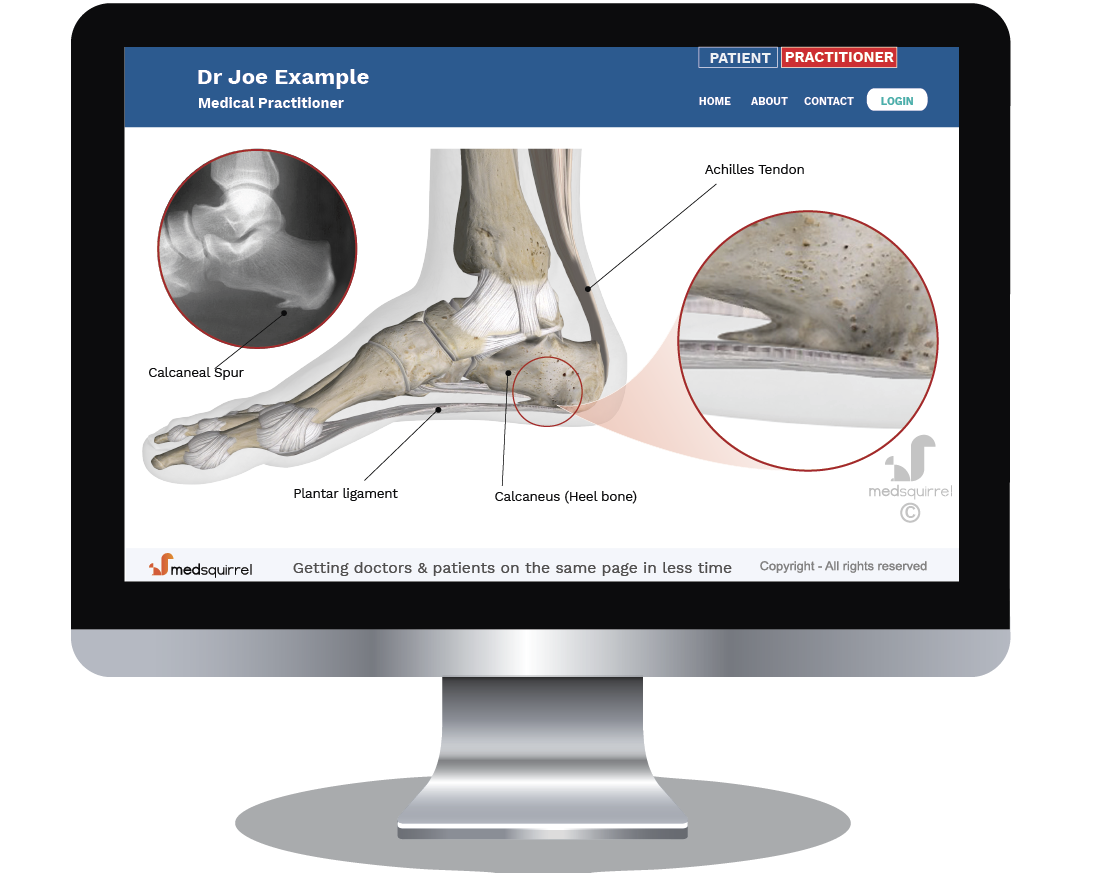
Well, actually not. But there are cyber-bots that do all of the above and much much more and can be hired for a pittance. MedSquirrel, an online collective intelligence platform is a good example. These platforms, developed by busy beleaguered doctors for busy beleaguered doctors, are the next generation of modern solutions designed to deal with patient centricity to cut doctors some slack. They centralise peer reviewed information and tools in one place to save you time, mental energy and effort. Since you are probably more of a medicine than a machine fan, the term magic genie or cyber-slave-to-doctors paints the picture (action man sounds to bit too sexist). For example, if you need some help to declutter your world and get to the nitty gritty of patient-education in super-quick time, you can delegate it to the platform: “Go tell that patient why a bacterium is not a virus!”
Or, in your rooms, when you are running late: “Help! My patient is all choked up with emotion and I need to extract some useful facts before I can proceed!”
How about: “Help me explain [virtually any very-complicated-medical-concept], I only have two minutes to spare!” Obviously, without a visual, this will never be possible.
Since many other doctors, no doubt, need to solve the same problem, collective intelligence will swing into action, activating more like-minded brains to provide better solutions. Shared knowledge, crowdsourcing and peer-to-peer collaboration also offer far more realistic prospects to develop practical solutions that can continuously be improved upon through critical thinking, stress testing in practice and a relentless drive towards innovation.
This is our future. There is hope and help out there. We help patients, so why not help each other? We’re all in this together and collectively with some basic technology and a few good ideas we can easily get back to enjoying our careers. Two gestalts are better than one, but a smorgasbord of minds may be the real-McCoy of magic genies.
 Powered by Majestic3.com