Google Shopping is Broken - Here’s How to Fix It
by Andreas Dzumla & Mark Oelofse


 |
| Andreas Dzumla |
CEO & CO-FOUNDER, LONGTAIL UX
Andreas is a marketing thought leader and the co-founder of Longtail UX, a patented search experience marketing platform that connects customers to products in one click. Andreas is an ex-Googler and Dentsu Aegis Network agency executive who’s seen search marketing from all sides. At Google, Andreas was on the team that launched the very first version of AdWords Editor.
His international experience spans Europe, US and APAC and his unique industry insights inspired the birth of Longtail UX. The platform uses AI to help brands and agencies grow incremental SEO and SEM revenue by up to 400%.
Andreas is a regular speaker at industry events.
 |
| Mark Oelofse |
GLOBAL SALES DIRECTOR, LONGTAIL UX
Mark in an international sales executive who has worked in the US, UK, Africa and Europe. He brings two decades of global technology industry experience to Longtail UX, having previously driven growth for industry leaders such as Microsoft, KPMG, Software AG and Sun Microsystems.
Mark has been involved in scaling innovative SaaS companies internationally, which makes him a perfect fit for taking Longtail UX’s revolutionary solution to market.
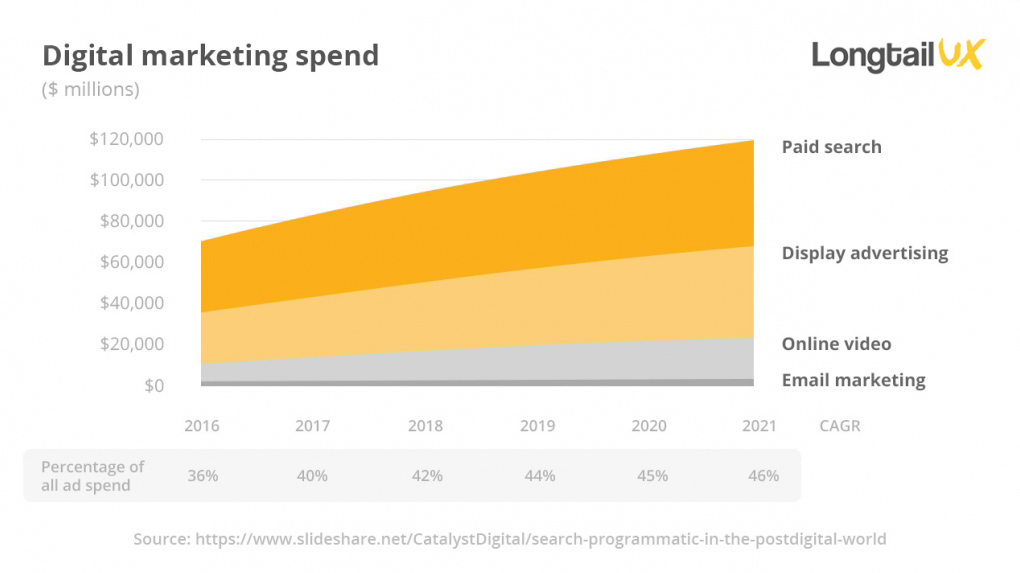
Chances are, you’ve searched Google at least once today before reading this. Despite the exponential and incessant increase in marketing channels, search is by far the most dominant when it comes to driving ecommerce traffic.
A study carried out by SEMRush found that organic search is the second largest source of traffic for ecommerce businesses, just after direct visits. For the top twenty five US-based e-tailers, search represents as much as 37.5% of all traffic sources.
In fact, Forrester projects that search marketing will continue to command the majority of digital ad budgets in the coming years, despite the faster growth of newer channels.
As the digital landscape evolves and adapts by the minute, it’s certain search has changed along with it.
Google no longer rules the roost when it comes to product searches. There’s a new kid in search engine town and it’s redefining how people find products online. Over the last couple of decades, Google was the undisputed king of any and all web searches, but with the rise of product specific search queries Amazon has slowly cornered this billion dollar niche.
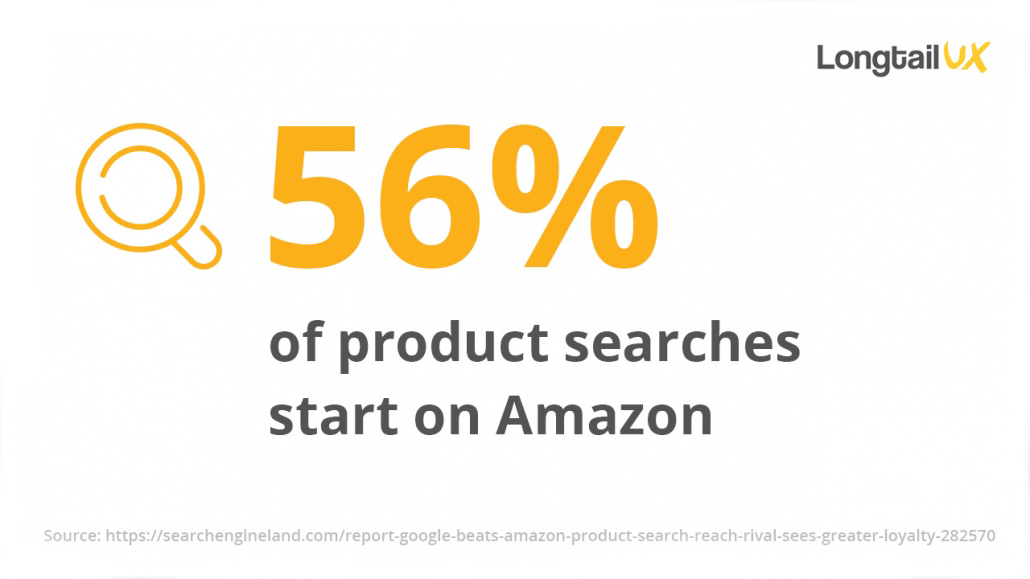
Kenshoo found that in the world’s largest ecommerce markets, 72% of shoppers have used Amazon and 56% use it as their default go-to product search engine.
So, where does this leave Google in your ecommerce marketing mix?
And why has it lost the battle for product search mindshare?
Simply put, we’re sick of clicking.
In a marketing world that is now all about the customer experience, ‘experience’ is sorely lacking when it comes to Product Listing Ads (PLAs).
To illustrate, let’s say you’re in the market for a beige handbag. You run a search for that keyword combination and trust that Google will return the most relevant results for your query. In this case, as with the majority of product-related searches, Google will serve up a bunch of PLAs with images of various beige handbags.
So far so good.
But when you click on any of these ads - you land on a page with a single product. Despite the fact that the ecommerce website may have 5, 20 or even several hundred more beige handbags.
The problem being, the customer will never know as there is no easy way to find them!
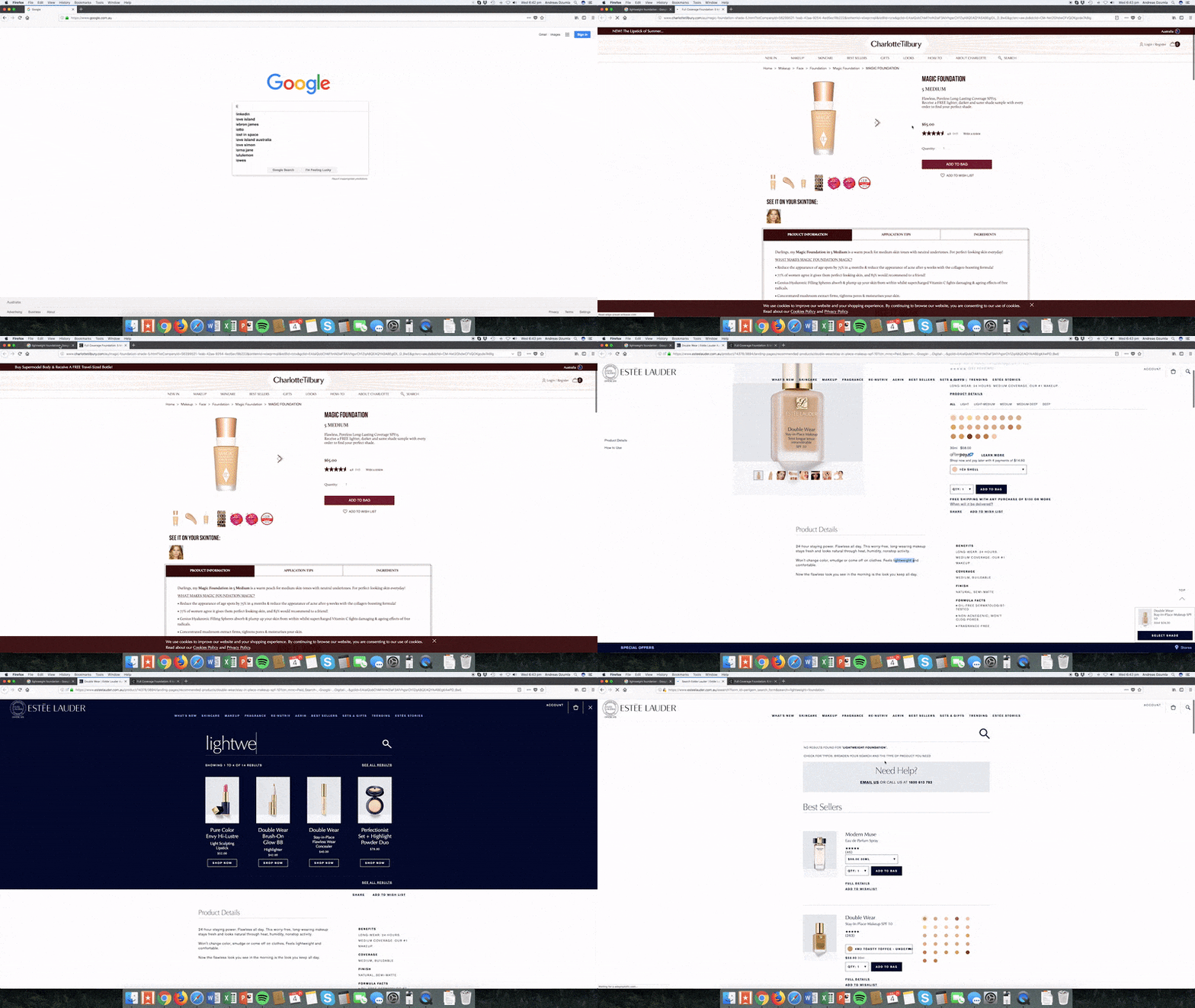
Even in cases where Google shows multiple PLA ads from the same website, you still have to click back and forth in order to see all the matching products from that retailer.
The bad CX is not Google’s fault, though.
Google created PLAs with the best intentions to solve a very real-life problem for advertisers: creating paid search campaigns for large product catalogues manually is a tedious process – and for fast changing inventory it is virtually impossible. So the automation of the process, creating ads and targeting keywords directly from your product feed, was a great step forward for marketers.
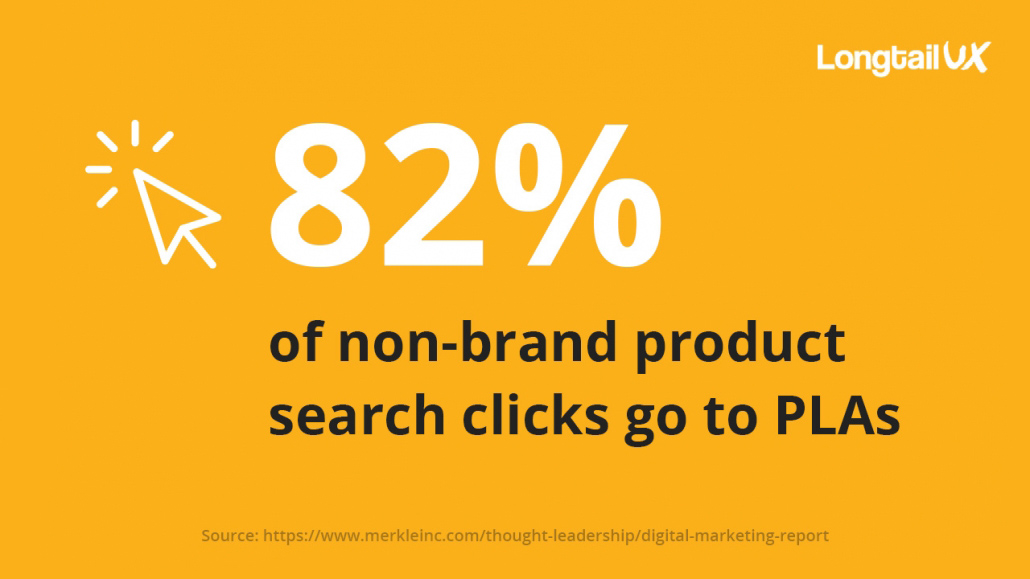
The process was now much less laborious and the relevance of the targeted keywords was guaranteed by Google’s algorithms. And, for a time, it seemed to do the trick: According to a recent Merkle study, 82% of non-brand product search clicks are going to PLAs these days.
Yet, this seemingly beautiful simplicity of PLA product feeds is a huge frustration for users: all Google has to work with is single-product landing pages.
So for 82% of product related searches the only thing the user ever sees is one product at a time, click by click, by click, by click, by click...
As a result, such a customer journey is often over before it even begins. And when you only have a few seconds to capture someone’s attention online...
Well, you’ve just lost another potential shopper.
As an ecommerce marketer, you know that Google Shopping is flawed. The above example serves to vividly illustrate this point.
But you also realise that Google remains a strategic channel that will continue to send high-intent traffic to your product pages long into the future. Especially, when it comes to longtail keywords, which are ecommerce’s real conversion drivers.
In addition to this, voice search is projected to represent more than 50% of all search queries in only a couple of years’ time. Given that voice search IS longtail search, this growing trend will ensure Google’s continued relevance to your marketing strategy.
The questions is, is your brand sufficiently prepared for the longtail revolution?

While most marketers don’t think of search marketing in this way, the channel is an important component of a brand’s overall CX.
Given the high conversion value of longtail searches in particular, this makes them an even more important part of your omnichannel CX strategy.
Why?
Because, unlike other channels that make up the often-subjective totality of a brand experience, longtail keywords can very clearly be linked directly to revenue generation.
If someone Googles a “beige handbag with white sequins and a heart-shaped lock” then you better believe that such a search will deliver dollars and cents to an e-tailer.
And if your PLA leads to a landing page with one result despite the fact that you have ten or a hundred in your catalogue, then that e-tailer most likely won’t be you.
One of Amazon’s secrets is its ability to show all matching products and countless other related products for any search. This provides a large number of highly relevant products in response to a query such as the one above.
So, how can you Amazon-ify the Google Shopping experience for the benefit of your brand’s online shoppers and your bottom line?
More importantly, how do you connect the millions of such longtail queries to your product catalogue on autopilot?
Automating such a momentous task in a way that improves searchers’ customer experience seems not only daunting, but almost impossible.
Especially, if your online inventory spans thousands, hundreds-of-thousands or even millions of products that are constantly changing. As it does for many ecommerce businesses.
As an ex-Googler, Andreas Dzumla first saw the flaws of Google Shopping from the inside out. Afterwards, as General Manager for an agency that’s part of the global Dentsu Aegis Network, he then experienced it from the outside-in.
Seeing global brands such as Vistaprint, Woolworths, Officeworks, Bupa and IAG spend millions of dollars a month on search and, sometimes, hundreds of dollars on a single click, Andreas and his co-founder realised that ‘the longtail’ - combined with automation - was the key to improving CX while driving additional search revenue.
After spending a significant amount of time on R&D and drawing on his knowledge as an ex-Googler and agency executive, he released the first iteration of the Longtail UX search experience automation platform several years ago.
In a nutshell, Longtail UX uses proprietary artificial intelligence and machine learning technology to connect longtail searches to relevant products at scale. The patented platform has no equivalent internationally and has been used by leading ecommerce businesses to drive incremental revenue from their search channels.
Here’s how the technology works:
And the best part? These ads can run alongside your PLAs, so there’s no need to sacrifice anything - the revenue generated by Longtail UX is all incremental.
The difference: ONE click to see 84 matching products
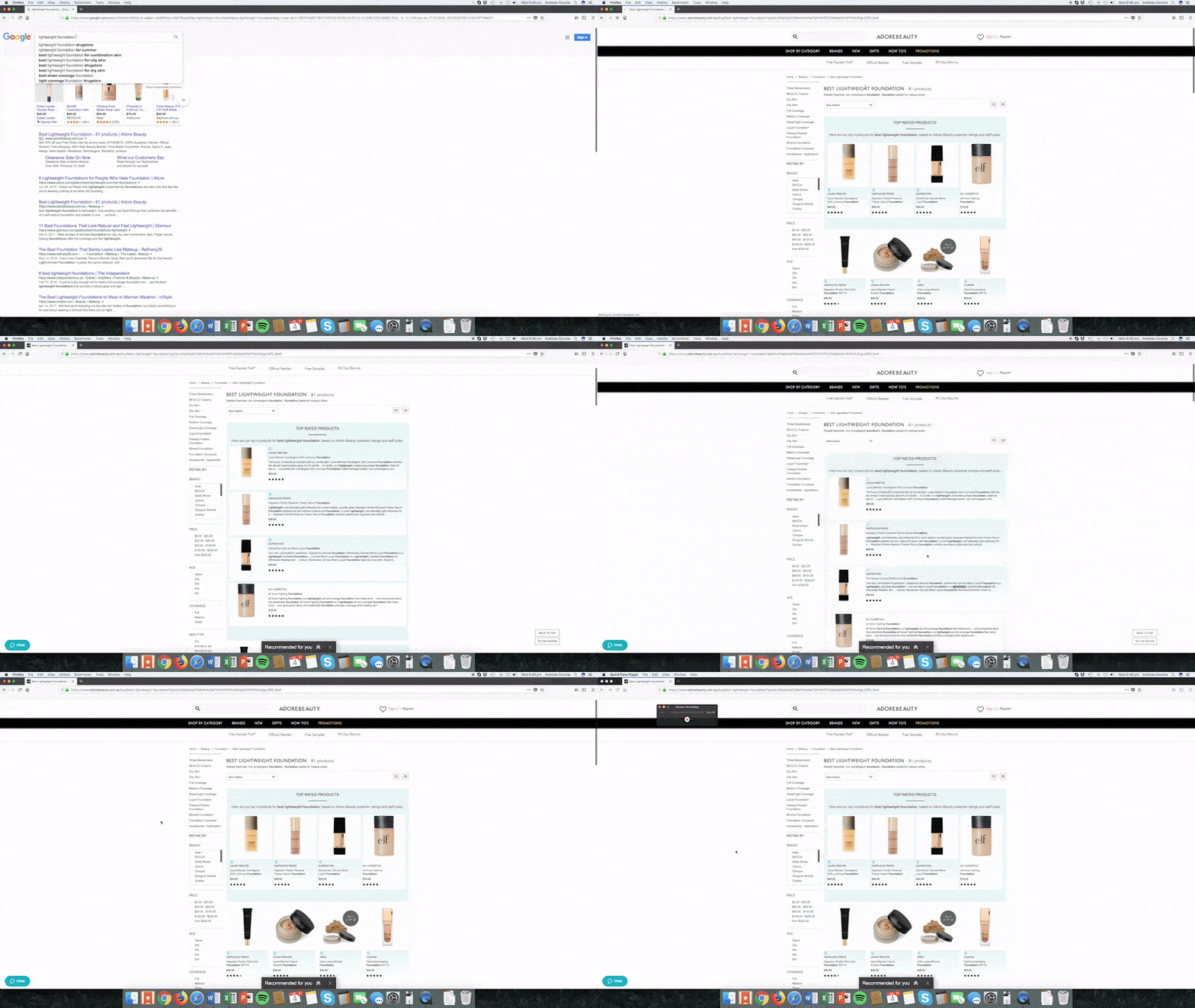
The Longtail UX solution allows a brand to extract additional revenue from both SEO and SEM / PPC channels regardless of whether it is an ecommerce business or not.
It can unlock the value of search in any industry that has a high volume of longtail queries.
Apart from ecommerce, it’s been used for growing revenue using the search channel for marketplace and financial service clients by as much as 400% in SEO and up to 50% in SEM.
Deploying the Longtail UX SaaS platform takes a little as two days:
GraysOnline (#5 ecommerce site in Australia)
A strong, well-known brand with high ‘branded search’ keyword traffic volumes, but lower SEO coverage for non-branded keywords, despite having had over 7 million pages indexed in Google.
Longtail UX helped this enterprise ecommerce customer achieve the following results with no increase in marketing headcount:
 Powered by Majestic3.com