

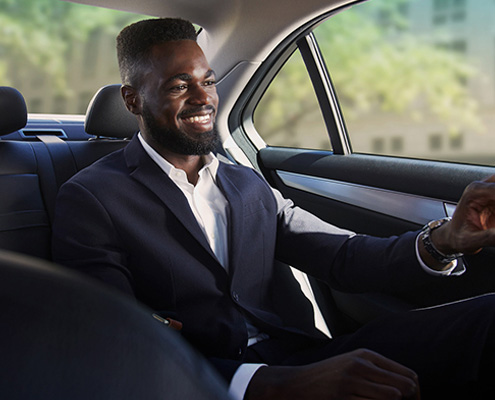
We live in a world that is time and attention starved. We are constantly moving, hustling and we fill our days with a back to back schedule. There is no time to sit and think and be still...except of course when we are in an Uber.
Advertisers the world over are battling for customers’ attention – and losing the battle. As Georg Franck writes in The Economy of Attention, it is primarily attention, rather than money, that advertisers are seeking. It is true that money follows attention, so how do we capture the attention of the public in a crowded and noisy marketplace?
Uber riders are pure gold in advertising terms: they are high-income earners, tech-savvy, information hungry, and own smartphones and credit cards. But the most valuable aspect is that they have time. A 20+ min gap in their day that they have not planned for and is largely open and uninterrupted.
This is where Hubble has made the breakthrough. The next time you step into an Uber vehicle, you may be seated behind a tablet offering entertainment, music, information and targeted interactive advertising. You can watch videos, engage with new products, play a game, or receive a discount.
Confronted with the same messages in any other setting, research suggests there is a strong possibility that users would ignore or skip the message. The engagement takes on a different level of intimacy when you have the time and the curiosity to enjoy the experience.
Hubble has 700 screens currently in use in South Africa – a figure that should increase in the coming months. For 20+ minutes, your brand can have the attention of a highly sort after Uber demographic with nothing else to do than explore.
The 20-minute mindset

In a world where we are bombarded with advertisements, agencies and brands find themselves struggling to make their messages heard above the noise. Measurability has become the norm. However, nothing is said of how to measure the state of mind of an audience.
We might know exactly how many people viewed an ad but how many people did we annoy in the process? Were they open to viewing it or did it interrupt their day and end up creating a negative brand perception? If 5% of people viewed your ad, could potentially 95% be irritated by it?
Consideration needs to be made as to how a mindset of someone who is in a calm environment can affect their response to advertising. Uber riders are the one group which we can now target as they always have an uninterrupted space with the ability to opt into a brand building experience. This 20+ minutes of unusual free time completely changes the mindset of how people engage with brands.
The headrest-mounted touch screens allow the user to explore and control their own experience which results in people lowering their defences and becoming more receptive to brands. These are the times when consumers become open minded and move from just and awareness phase into consideration, building trust and the foundation for a conversion.
Brands can measure DOOH (for real)
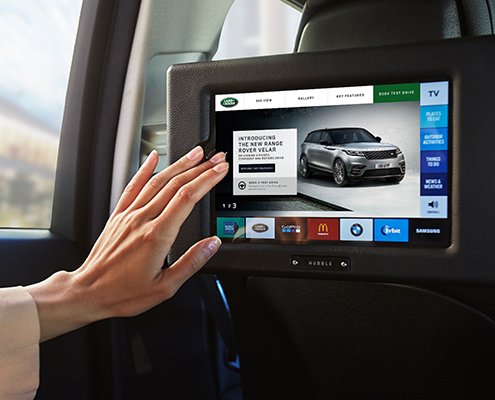
Tracking real return on investment (ROI) for brand managers in Digital Out-of-Home (DOOH) settings is often challenging. Opportunities to view or estimated reach have always been the measurements in the Out-of-Home space.
It is now possible to receive far more metrics than the standard Digital Out-of-Home campaign, through tablets placed in the back of Uber vehicles. ‘Brand Channels’, which are interactive experiences are sold in groups of 100 screens (vehicles), and can be coupled with standard video ads and geo-targeted ads. Hubble reports back to clients on the performance of their campaign against category averages, in what areas are the highest engagement, what times of day are more popular, video completion rates and engagement rate.
Brands can understand which products perform best on a public platform, educate your audience through a short journey or run a survey to get quick feedback from thousands of Uber riders. Targeted ads can push location-specific messages, for example, a message can be pushed to appear on a Hubble screen as the rider arrives at the V&A Waterfront, or picks someone up at OR Tambo.
Hubble is today live in 700 Ubers in South Africa and carries messages from major brands such as DSTV, MTN, Ster Kinekor, KWV, Renault and, of course, Uber.
In the near future Hubble will be offering a Cost Per Completed View for video ads and a Cost Per Click for interactive channels. This ushers in a new era of measurable Digital Out-of-Home, achieving a level of engagement and an ROI that was previously unattainable.
Who is the Uber rider?

From CEO’s to young graduates, Uber riders are an attractive target market. They are educated own credit cards and are tech savvy. But what else do we know about this unique audience?
Young Africans
The core of riders is aged 18-34 (60%) and aligns to the total population race split of 66% majority black. 55% of Uber riders are female.
Receptive to Media
The Uber audience tends to research products and brands online that they have seen on TV, watch live broadcasts on the Internet as well as to stream their favourite shows online.
Early Adopters
They do not see tradition as important as the total population, they see themselves as creative and are risk takers. They are adventurous and it is important for them to be successful.
Active Spenders
Middle to high-income earners that enjoy ordering things online, have a high-affinity to fashion trends and like to treat themselves to luxury items.
For brand strategists, Hubble is able to offer concrete facts on rider engagement, such as interactions per time of day and location, video completion rates and comparisons to industry averages. This data significantly increases measurability and contributes to the evolving media of Digital Out-of-Home, a category that has seen growth globally.
As the reach increases, so does the potential for brands to powerfully engage with Uber riders. With interaction rates as high as 8-10% and video completion often around 50%, it shows that Uber riders are not only available but curious and ready to explore. This, along with the growing data, measurability and improving technology, suggests in-Uber advertising is set to become a powerful DOOH player.
Speed to market
One of the difficulties in launching new Out-of-Home (OOH) campaigns is the high cost of producing content, and the length of time it takes to get the message to market.
Hubble solves this problem in two ways: using its in-house creative team to achieve fast turnaround times in campaign development, and then placing these messages in Uber vehicles in the key metros of South Africa – reducing campaign launch times from months to days or minutes.
Headrest mounted touch screens in Ubers are transforming the OOH category and bringing fresh creativity and digital reporting. Hubble has built a number of interactive campaigns for national brands and have plans to start selling video ad space in News, Music and Game of the Month categories. Restaurants, Events and Things to Do are listings that are rotated regularly and are opportunities for SMEs to reach Uber riders quickly and affordably.
Brand Managers can now easily include Uber riders in their communication strategies, which was previously next to impossible. Hubble is able to measure and report back how the campaign is doing and make adjustments quickly to maximise the impact.
No-one can afford to ignore this new marketing medium.
________________________
For more information, contact Hubble here:
info@hubbleafrica.com
www.hubbleafrica.com
021 461 0820
 Powered by Majestic3.com