Wot, Can't U Read?
Schools and Libraries Let's Develop UK Literacy!
by Jonathan BOnd & Natalie Charlton


 |
 |
Where there is a lack of literacy there is a lack of opportunity and this is something all of us should be putting our weight behind to ensure equality and the advancement of all people from all segments of the population.
Luckily, there are accessible and inexpensive resources like magazines available that will do a lot to improve reading skills.

In the UK, the literacy crisis is a lingering concern for educators and the general population alike.
But why has it been labelled a crisis?
“5.1 million people in England don't have the reading and writing skills expected of an 11-year-old”, Jonathan Douglas, Director of the National Literacy Trust wrote in an article for Huffington Post, adding “this means that they will be held back at every stage of their life”.
Despite numerous national strategies put in place attempting to curb the prevailing literacy problem, the National Literacy Trust and Experian have revealed that the literacy crisis remains “intensely local and deeply entrenched”.
Efforts to help students improve literacy skills have included the use of various resources that include high tech as well as low tech solutions.
These resources can also be used in combination with one another to reach literacy goals.
Furthermore, schools that may not be able to afford or gain access to high tech multimedia resources will still be able to gain access to more affordable low tech resources like magazines, which are more accessible and just as effective tools to encourage reading.

As effective as high tech literacy resources may be, they also require an increase in screen time exposure for students.
Dr Aric Sigman, an associate fellow of the British Psychological Society and a Fellow of Britain’s Royal Society of Medicine warns that children exposed to an excess of screen time at an early age may experience an impeded ability to focus, concentrate, communicate, build their vocabulary and lend their attention to others.
To prevent this, Doctor of Psychology, Liraz Margalit recommends minimising screen time so that kids can “understand the clear boundaries between the virtual world and the real one”.
Books and magazines are not associated with any of the risks associated with excessive screen time.

What then, you may ask, is wrong with simply making use of good old fashioned books as a way of improving literacy? Nothing whatsoever. Books remain a powerful tool to be used to encourage reading and better comprehension of written language.
However, to someone who finds reading a challenge, attempting an entire book may seem a daunting task.
In an article for The New Yorker, David Denby writes that young people have begun to associate reading with doing chores like “doing the laundry or prepping a meal”. Moreover, in another article for Forbes by Jordan Shapiro, kids don’t read books because “parents don’t read books.”
In the article, Shapiro explains that even “highly educated elite individuals” report no longer finding the time to read books.
Magazines allow for content to be consumed in more manageable “chunks” than a book might, and ideas communicated via a magazine can appear less threatening and more absorbable to an inexperienced reader.
Most books that children have access to are fiction, but reading nonfiction has unique literacy benefits.
Studies have found that reading nonfiction, specifically, can help to develop research abilities and grasping complex texts better among kids.
Magazines are a good example of easily accessible nonfiction reading materials.
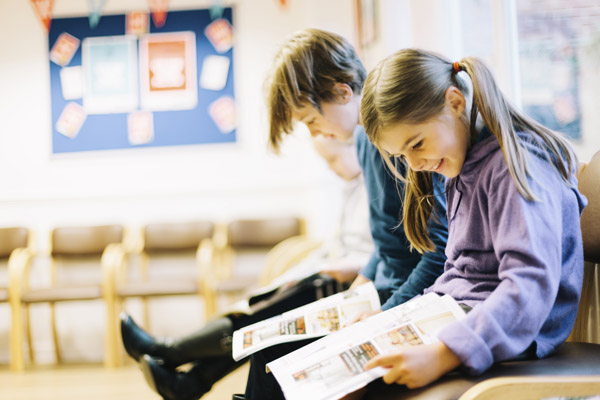
A simple, convenient, portable and cost-effective way to combat the literacy crisis is to make use of magazines.
Magazines use colourful illustrations and photos to convey information in an engaging way. They also often contain puzzles, poems, rhymes, crafts and stories that allow kids an opportunity to improve their spelling, vocabulary, narrative comprehension and grammar skills.
Magazines are richly diverse and the variety available can cater to most tastes. Reading about something that interests you makes the act an enjoyable one after all.
Some children are “visual learners
Reading magazines exposes kids to language, multiple genres and sophisticated narration that can be every bit as rich and engaging as that found in a book or interactive literacy computer programme.
Best of all? Magazines are fun.
 Powered by Majestic3.com